
Koochiching Release Mugshot Records
A booking photograph, often called a mugshot, is made as part of an arrest and booking record. It documents the person presented to the jail at that time. It does not prove guilt, conviction, current custody, or the reason a later release occurred. Release also does not erase the government’s maintained booking record.
Minnesota Statutes section 13.82, subdivision 26, classifies booking photographs as public data. Law enforcement may temporarily withhold access when release would adversely affect an active investigation. Other lawful limits can apply to juvenile, sealed, expunged, misidentified, or otherwise restricted records. The Sheriff should make the classification decision on a request for a Koochiching image.
Where Koochiching Release Mugshots Appear
The official and secondary channels do not provide the same evidence. Some display current booking photos. Others may preserve a dated image after release but fail to reflect a later correction, court order, or expungement. Use the narrowest official source that answers the question.
| Channel | Has a photo? | How to access |
|---|---|---|
| Koochiching current roster | Yes, a “Front Mugshot” column | Open the PDF from the official county Jail page and note its print date. |
| Sheriff records request | Potentially | Identify the booking and request the photograph, subject to classification and redaction. |
| Sheriff mobile app | No verified channel located | No official Koochiching Sheriff inmate-photo app was linked in the county sweep. |
| Minnesota DOC Locator | No photo in reviewed detail examples | Use for custody status and dates, not as an offender mugshot gallery. |
| VINELink | Not a dependable photo archive | Use Minnesota VINE for county-jail custody checks and alerts. |
| Dated archives or news | Sometimes | Treat only as an old lead and return to the original agency record. |
Koochiching Roster Mugshots After Release
The Koochiching Sheriff’s live PDF includes front mugshot, name, age, arresting agency, arrest date and time, charges, bail, release date, print date, and total records. Its official gateway is the Koochiching County Jail page. The page shown below is the county source that points readers toward the active roster.
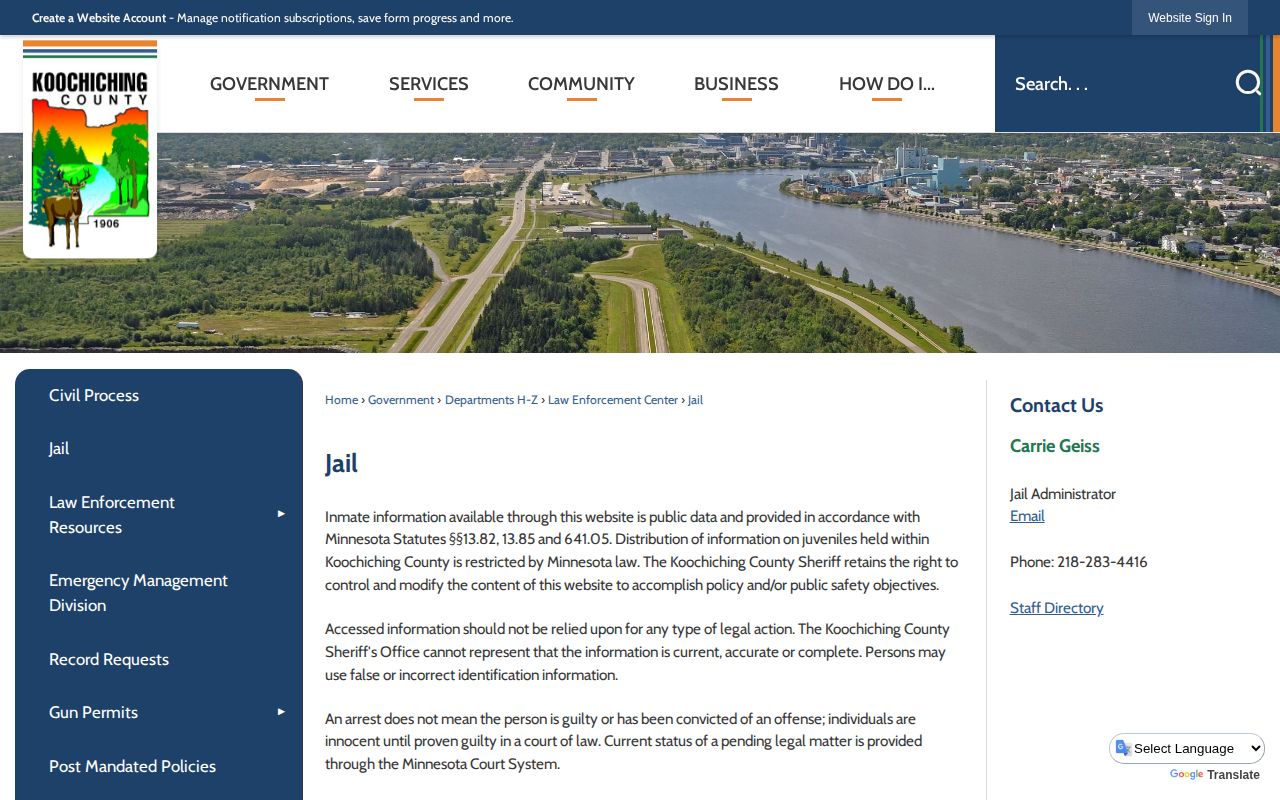
The screenshot identifies the correct government gateway. The roster itself is replaced over time, so its current-custody design cannot be converted into a dependable released-person photo archive.
On the research observation date, release-date cells in the live entries were generally blank. A person’s absence from the next PDF could mean release, transfer, correction, or another roster change. The image proves only that the official report associated that photograph with a booking at the time printed. For release time and destination, obtain the Sheriff release record.
Does Koochiching Have a Mugshot App?
No official Koochiching Sheriff mobile app with current or recent inmates and photos was located or linked during the county site and app sweep. Do not rely on an app simply because it uses a sheriff badge, county name, or jail wording. The county’s CivicPlus account tools relate to site notices and form progress, not custody photos.
VINELink has a mobile app, but it serves a different role. Minnesota VINE checks county-jail custody and can send status-change alerts. It is not a Sheriff mugshot application or a recent-release photo gallery. A VINE result can help identify a custody episode, while the booking image still comes from the Sheriff’s record.
Request Koochiching Booking Photos
Once a released person drops from the rotating roster, a focused Sheriff Information Disclosure Request is the most direct official photo route. Provide enough detail to identify the booking without requesting unrelated personal data. Ask about electronic delivery and cost before choosing media.
- Record the person’s full name, known alias, booking or arrest date, and case number if available.
- Use the Koochiching Sheriff Information Disclosure Request and describe the specific booking photograph sought.
- Cite the booking event, not just a current custody claim. Ask the Sheriff to classify the record under Minnesota chapter 13.
- Ask whether electronic delivery is available and request a cost estimate before work begins.
- If access is withheld or redacted, request the basis and follow the agency’s process for clarification or correction.
The local Information Disclosure Request posts a $25 charge for a digital-photo CD. That listed medium may not be the only practical delivery option, so confirm the current fee and ask whether an electronic copy can be supplied. The Civil Division is listed at 218-283-1141, Monday through Friday, 8:00 a.m. to 4:00 p.m. The main Law Enforcement Center number is 218-283-4416.
The full county records path is covered in the Koochiching released-inmate record search. It can help match the photograph to the release date, release authority, and receiving agency without treating the image as proof of the later outcome.
Koochiching Mugshot Publication Rules
Koochiching’s actual publication practice has two parts. The rotating Sheriff PDF publishes a front mugshot with current roster data. The formal disclosure form separately lists a digital-photo CD fee. Minnesota law says booking photos are public subject to temporary active-investigation withholding, but public classification does not require the county to keep a permanent online gallery.
No enacted Minnesota anti-pay-to-remove law was found in the research sweep. A 2014 proposal, House File 1940, did not become the statutory guarantee sometimes claimed online. Commercial mugshot sites should not be paid, endorsed, or linked as though they were official. A removal issue should instead use the publisher’s process, a correction from the originating agency, an applicable court order or expungement, and legal advice when needed.
Note: A public government record and a privately copied image can follow different correction or removal processes.
Koochiching DOC Photo Limits
The reviewed Minnesota DOC Locator detail examples did not display an offender photograph. DOC’s public photos and videos area contains institutional media, not a searchable offender mugshot collection. The Locator remains useful for determining whether someone moved from county custody into state prison or community supervision, but it should not be described as a photo source.
A requester may ask Minnesota DOC Records Management whether an intake or identification image is maintained. DOC must classify that record under chapter 13 and section 13.85. Availability cannot be promised. A county booking image and a later DOC identification image can also depict different custody events, so label the source and date rather than calling either one the person’s current mugshot.
Check Koochiching Mugshot Context
Dated third-party roster snapshots may show that a person appeared on an earlier Koochiching roster. They can be stale, incomplete, or detached from a later identity correction, transfer, court order, or expungement. Never use an archived image to state current custody or the reason for release. No commercial mugshot or aggregator source is linked here.
Local news may reproduce an agency photo in a dated arrest report. The article documents what was reported then. It is not a Sheriff release database. Check the story date and credited agency, then compare the underlying court and release records. The absence of a follow-up report does not mean the person stayed in custody.
Image matching requires care. Similar names, aliases, reused stories, and cropped captions can connect the wrong person to a booking. If the source cannot support identity and event, do not republish the image. An agency correction should take priority over an old copy.
When Koochiching Mugshots Are Expunged
Release from jail, discharge of a sentence, and expungement are three different events. Release ends a custody episode. Discharge ends the relevant sentence or supervision term. Expungement is a court or statutory process that seals covered records. Minnesota automatic-expungement waiting periods for qualifying convictions run from discharge of the sentence, not the earlier jail exit.
Current waiting periods vary by offense class. A petition route may add notice, hearing, decision, and appeal time. The Minnesota Judicial Branch provides official criminal expungement help. An expungement order should be read for its scope because not every private copy vanishes at once. Give the order to the agency or publisher named in a correction request. If the official source has sealed, corrected, or withdrawn the record, continued use of an unsupported image creates a serious risk of false context.
Verify Koochiching Release Mugshot Identity
Connect the image to four facts: the named person, the booking event, the source agency, and the source date. Then keep arrest, charge, conviction, custody, release, and discharge separate. A booking photo supports none of those later outcomes by itself.
- Use the roster print date to frame when the photo appeared.
- Match the booking to the arresting agency and court file.
- Obtain the release record for actual release time and destination.
- Check for later correction, sealing, or expungement before reuse.
- Remove or suppress an image when identity or legal status is no longer supported.
When a released person requests correction, compare the contested image with the Sheriff’s source and the court file before repeating it. A wrong caption, merged identity, or photo from a different booking should be reported to the publisher and originating office. Preserve the request, response, and any court order. Prompt correction is more reliable than assuming an old copy remains accurate merely because it is still visible.
This process preserves the evidentiary value of an official image without turning an old arrest record into a claim about current custody or guilt.