
Federal BOP Release Paths
The Federal Bureau of Prisons holds sentenced federal prisoners and manages federal community-corrections placements. No BOP prison was identified in Koochiching County. A federal defendant with a local connection may first be held in a county or contract bed under the United States Marshals Service, then transferred after sentencing and designation. The person may not yet have a useful BOP location result during that early stage.
A BOP exit can mean release to the community, transfer to another correctional authority, movement through a residential reentry setting, or another lawful status. A separate detainer can take effect when BOP custody ends. Therefore, a historical release date concerns the Bureau’s custody episode. It should not be expanded into a claim about every other agency.
Federal BOP Release Record Search
The BOP Inmate Locator covers federal inmates from 1982 to the present. A register number is the clearest key. The system also permits searches by DCDC, FBI, or INS number, or by name with optional age, race, and sex fields. A name-only match should be checked against the displayed register number and demographics.
- Choose the identifying-number search when a federal number is known.
- If searching by name, use the full federal name and available narrowing fields.
- Compare all identifiers before selecting the person.
- Read the displayed release date and location or status literally.
- Check the federal court and USMS path if the person is a pretrial detainee or does not yet have a BOP designation.
The locator’s result fields include name, register number, age, race, sex, release date, and location or status. “Released” with a date is the historical BOP indicator. The date can change through sentence recalculation and credits, so preserve the date of the search when timing matters.
The official federal inmate locator appears in the subject-matched capture.
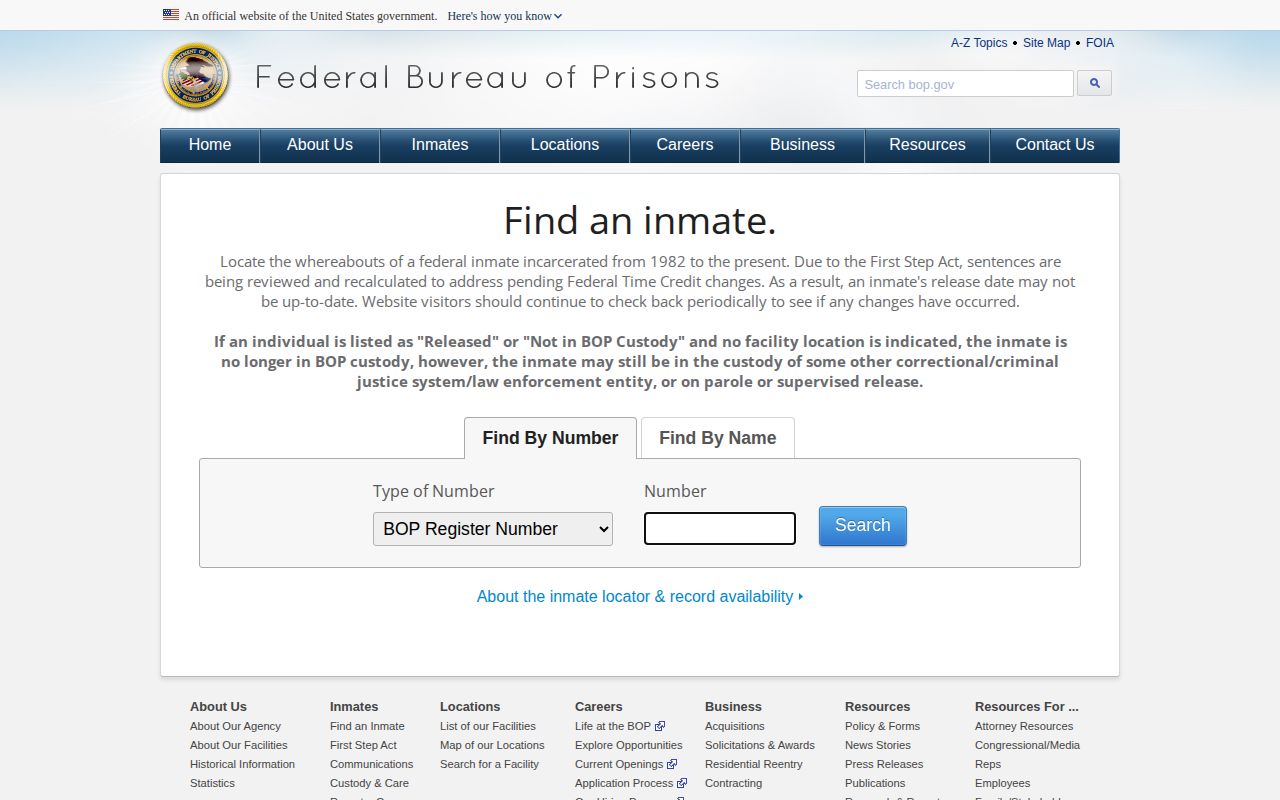
The national interface is the right public source for a sentenced federal prisoner, not for an ordinary county booking.
Federal BOP Release Result Fields
A federal result becomes useful when each field is kept within scope. The locator is not a county booking report and does not explain every event that occurred before or after BOP custody.
| Field | What it answers |
|---|---|
| Register number | Identifies the federal person record and reduces same-name error. |
| Release date | The recorded or projected end point for the BOP custody episode. |
| Location/status | The current or historical BOP category shown by the federal system. |
| Age, race, and sex | Narrowing fields that help confirm the correct person. |
| Not in BOP custody | A broad statement that does not exclude another correctional system. |
Federal court records provide the judgment, sentence, later orders, and supervised-release terms. The BOP supplies its custody and release result. The USMS district or holding facility handles pretrial and transport questions. When the person first left Koochiching County Jail on a federal hold, the sheriff’s transfer record is the source for that local handoff.
Note: A BOP release date does not establish the earlier Koochiching jail transfer time or the end of federal supervision.
Koochiching Federal Transfer Records
A Koochiching County roster may name an arresting or holding agency, but that entry does not prove the final custodian. If a person vanishes while a federal hold is active, ask the sheriff for the release or transfer event. Minnesota §13.82 identifies the date, time, legal basis, and recipient agency among the public transfer fields, subject to lawful classification. The recipient-agency entry can show whether USMS or another authority took custody.
Next, inspect the federal court docket or ask the responsible district for the appropriate location route. USMS detention often uses contract beds rather than one dedicated, searchable prison. Once a sentenced person is designated to the Bureau, the BOP Locator becomes more useful. A delay between local transfer and a federal result should be treated as a processing interval, not a community release.
| Stage | Best confirmation |
|---|---|
| Koochiching jail handoff | Sheriff transfer record and recipient agency |
| Federal pretrial detention | Federal court, holding facility, and responsible USMS district |
| Sentenced federal placement | BOP Inmate Locator |
| Historical BOP release | “Released” result and BOP record request |
| Immigration custody | ICE locator, not BOP |
Federal BOP Release Record Requests
When the locator gives too little history, use the BOP FOIA and Privacy Act process. Identify the person by full name and federal register number, then describe the maintained release or custody record needed. A narrow request can ask for the BOP release date, custody-status history, designation history, or another identified record. Access and redaction depend on federal law and the requester’s status.
National Inmate Locator
Federal prison status and release results
FOIA/Privacy Act process for maintained records
BOP does not own the sheriff’s booking file or the federal court judgment. Request local release or transfer data from Koochiching County. Obtain court orders from the federal court. Use BOP for the federal prison episode. This division avoids asking one office to create a narrative or research records held by another agency.
- Designation
- The BOP decision assigning a sentenced person to a federal facility or placement.
- Detainer
- A legal request or hold that may send a person to another custodian when BOP custody ends.
- Federal supervised release
- Court-ordered community supervision after imprisonment, distinct from BOP confinement.
- FOIA
- The federal public-record process used to request existing agency records, subject to exemptions.
Federal Release Versus Supervision
A BOP “Released” result does not mean the entire federal sentence is over. A federal court may impose supervised release to follow imprisonment. The probation office and federal court, not the prison locator, own that community term. Violations can lead to new court action and custody. The locator’s historical release date remains the end of a BOP episode even if supervision continues.
Release dates can also be recalculated. BOP specifically cautions that dates may change, including through First Step Act credit calculations. Treat a future date as forward-looking and check it again. For a past event, preserve the status and search date, then obtain the maintained record when an exact official history is required.
The Koochiching County release-record search supplies the county roster, court, and sheriff request steps that precede the federal path. Those sources are vital when the question begins with disappearance from the local roster.
Koochiching Federal Release Boundaries
International Falls lies near an international border, but geography alone does not establish BOP custody. A local arrest can remain a county or state matter. A federal agency can participate without the person ever becoming a sentenced BOP prisoner. ICE civil detention is separate from the federal criminal prison system. Each path needs an agency-specific result.
Start with the known case and holding authority. If the county record identifies a federal transfer, trace the USMS and federal court stages. If BOP later shows the person, use the federal result for prison status. If ICE took custody, use the immigration locator. This sequence answers where the person went and keeps “released” tied to the custodian that actually recorded it.
A federal court’s judgment is also the source for any term of supervised release after prison. That community term is administered outside BOP confinement and can continue well beyond the Locator’s release date. A later violation or court order may create another custody episode. Read the docket chronologically so the first federal release is not confused with a later return.
For an old result, note that the BOP public locator begins with federal inmates from 1982. Earlier records require a different archival inquiry. For covered years, the register number remains the strongest search key. If a person has the same name as another result, do not rely on age alone. Compare every displayed identifier with the court case before attributing the release.
Federal credits and sentence computations can alter a future date. The First Step Act is one stated reason BOP dates may change. The public screen should be checked again near the anticipated event, and an exact past custody history should come from the maintained federal record. A forecast is not confirmation that the exit occurred.
Note: No BOP prison was identified in Koochiching County, so use the national system rather than inventing a local facility.