
Koochiching Projected Versus Actual Release
The Minnesota DOC Locator uses “Anticipated Release Date.” That label is the exact public field for an incarcerated state offender. It estimates movement from confinement into supervised release or another lawful status under the current sentence calculation. It is not the same as a county booking release timestamp, a Supervised Release Board review date, or final discharge from DOC authority.
A pretrial detainee usually has no fixed release date. Release may depend on bond, a court order, dismissal, transfer, or disposition of the case. A sentenced Koochiching County jail inmate may have a sheriff-calculated date based on the commitment and jail credit. The actual event is proved later through the custodian’s release record. The official Jail page provides the current-roster gateway, while that record can state the date and time, manner of release, and whether the person went to the community or another custodian.
Search Koochiching Projected Release Records
Use the source that owns the calculation. Minnesota DOC dates apply to people committed to the Commissioner. County jail computations remain with the Sheriff and the sentencing court. A name disappearing from Koochiching’s current roster cannot tell which path occurred.
- Identify the current custodian through the Koochiching jail roster, court file, and Minnesota DOC Locator.
- For state custody, search by Minnesota DOC ID when possible. Match name, aliases, birth date, and court file before opening the detail.
- Read “Anticipated Release Date,” “Current Status,” the status “as of” date, and “Expiration Date” as separate fields.
- For a county sentence, obtain the judgment and ask the jail to confirm its current calculation. Do not apply the state-prison formula yourself.
- After the predicted day, confirm the actual result through DOC status, the jail’s release record, or the recipient agency if a transfer occurred.
The Koochiching County release search provides the broader path for obtaining the county record when the online roster no longer shows the person.
Koochiching DOC Release Date Fields
The Minnesota DOC Locator is statewide. It is not a mirror of the Koochiching County Jail. The official search screen shown below is the suitable public source for a state-prison date.
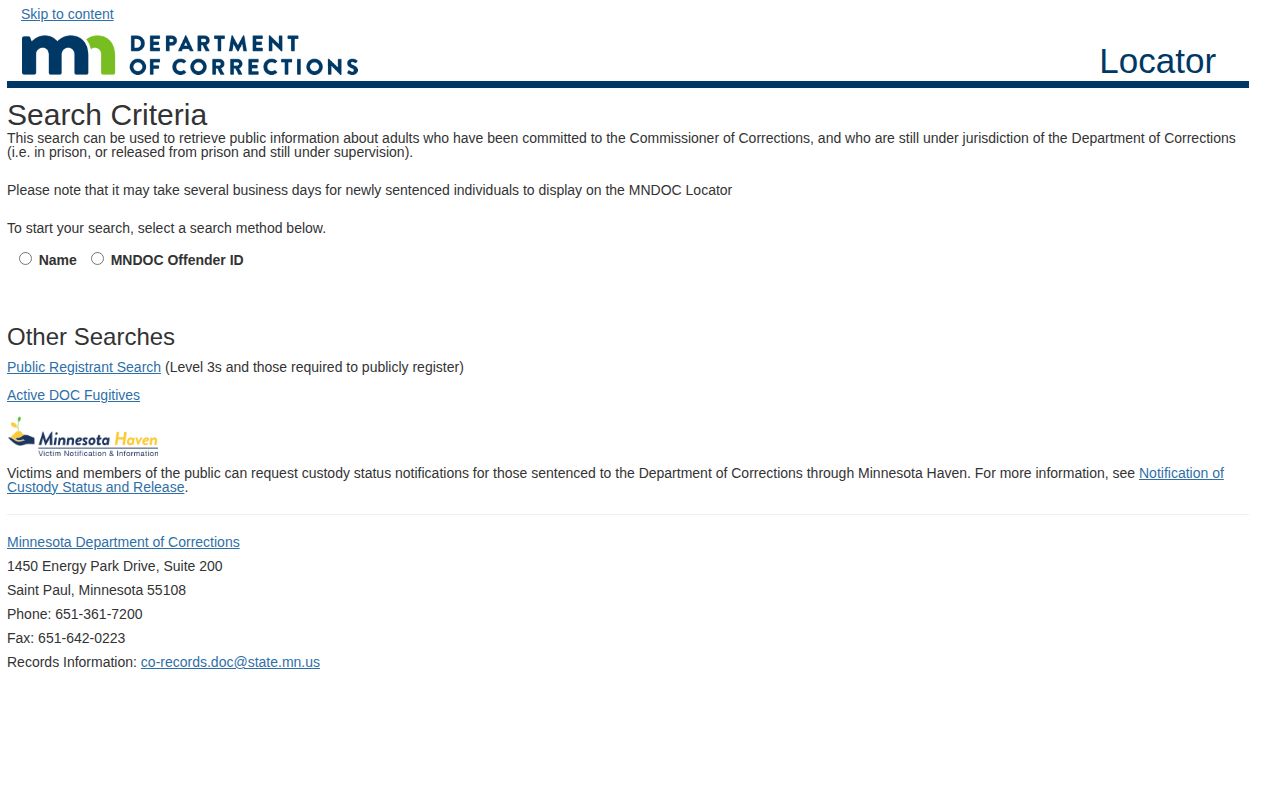
The screen begins the identity match. The person-detail fields must then be read together, because one date cannot describe confinement, supervision, and final discharge at once.
| DOC field | Use | Limit |
|---|---|---|
| Anticipated Release Date | Current projected move from incarceration | May change before release |
| Current Status and “as of” date | Shows incarceration, supervision, or another displayed status | A status snapshot, not a full history |
| Expiration Date | Displayed end of DOC jurisdiction or sentence | Not the prison door-out date |
| Last release field, when shown | Historical release clue | Must be read with its exact label and current status |
Koochiching Release Is Not 85 Percent
Minnesota’s ordinary determinate framework is not a universal 85-percent rule. For most qualifying felony offenses committed on or after August 1, 1993, Minnesota Statutes section 244.101 divides the fixed executed sentence into a minimum imprisonment term of two-thirds and a maximum supervised-release term of one-third. Supervised release is still part of the sentence. It is not final discharge.
Exceptions matter. Life and indeterminate sentences, conditional-release terms, court amendments, consecutive sentences, and specialized statutes may produce a different result. The controlling judgment and current statute must be read before drawing a conclusion. This state formula also does not calculate a misdemeanor or gross-misdemeanor term in the Koochiching jail.
Note: “Two-thirds” describes a statutory baseline, not a guaranteed release date for every Minnesota sentence.
Koochiching Earned Release Credit
The Minnesota Rehabilitation and Reinvestment Act created earned incentive release credit for qualifying people who meet individualized rehabilitation-plan goals. Sections 244.41 through 244.45 address definitions, eligibility, how credit applies, and exclusions. Current rules should be checked when a date is used because amendments can alter details.
Research for Koochiching identifies a credit cap equal to 17 percent of the total sentence and a floor that prevents release before one-half of the sentence. These limits do not make credit automatic. Life or indeterminate sentences and other excluded cases receive different treatment. Credit may affect the imprisonment part while the full sentence still includes supervised release. The DOC calculation, not a private arithmetic estimate, controls the public anticipated date.
An individualized rehabilitation plan can include the goals and steps DOC uses to assess earned credit. The public locator does not expose every internal calculation behind its date field. If the anticipated date is disputed, ask DOC Central Records for the sentence computation and compare it with the judgment, warrant of commitment, and credited custody time. A family estimate based only on the pronounced sentence can miss jail credit, consecutive terms, a later amendment, or a period of disciplinary confinement.
Earned credit also should not be confused with probation or sentence discharge. A qualifying person can leave prison earlier within the statute while still serving the community portion of the executed sentence. The locator’s current status and expiration date help show that distinction. The actual terms remain case-specific, so a credit limit should never be advertised as a guaranteed reduction.
When Koochiching Release Days Shift
Minnesota Statutes section 244.05, subdivision 1a, changes some state-prison release days. For crimes committed on or after August 1, 1992, a scheduled release that falls on Friday, Saturday, Sunday, or a holiday begins supervised release on the first later day that is not one of those days. For a covered pre-August 1, 1992 offense, the rule moves to the last prior qualifying day.
This is a DOC state-prison rule. It must not be imposed on the Koochiching County Jail. Local release timing depends on the commitment, operational calculation, court action, and any transfer or hold. The source that controls the sentence must answer which rule applies.
Koochiching Jail Good-Time Calculation
Minnesota Statutes section 643.29 supplies county-jail good-time authority. The actual Koochiching computation depends on the commitment, credited time already served, sentence structure, discipline, and Sheriff calculation. A 2018 local jail handbook stated that Huber arrears or violations and termination from Sentence-to-Service could cause loss of good time. Those are historical policy statements and require current verification before use.
A detainer can also change the practical outcome. A detainer is a request by another authority to hold or receive a person. Thus, completion of local jail time may lead to transfer rather than community release. Ask for the recipient agency in the release record instead of assuming the projected date means the person will walk out free of custody.
Why Koochiching Release Dates Change
Sentence calculations are updated when the legal or factual inputs change. A moved date is not by itself proof of error. Compare the current locator field, judgment, and DOC Central Records calculation.
| Factor | Possible effect |
|---|---|
| Jail credit correction | Changes time credited before the prison term. |
| Amended judgment | Changes the legal sentence DOC must administer. |
| Concurrent or consecutive treatment | Changes how multiple terms overlap or stack. |
| Disciplinary confinement | Can postpone movement into supervised release. |
| Earned incentive credit | Can reduce qualifying imprisonment within statutory limits. |
| Release-plan or custody change | Can delay or alter the expected transition. |
| SRB decision | A projected date may be assigned, conditioned, continued, or rescinded. |
Disciplinary confinement can extend the time spent in prison when the applicable rules permit it. A corrected jail-credit award can move the date in the other direction. Concurrent terms run at the same time to the extent the judgment permits, while consecutive terms are served one after another. Those terms describe sentence structure, not a choice made by a public search tool.
A Supervised Release Board review adds another layer for a narrow set of life, older indeterminate, and juvenile-at-offense cases. The Board may assign a projected release date or continue the matter with directives. That scheduled review is not a release. A grant may remain subject to a release plan and other prerelease conditions, and it can be rescinded before the custody change. Approved Board minutes should be read for the exact action rather than reducing every outcome to “approved” or “denied.”
For a pending county-jail custody change, Minnesota VINE can provide an alert. State-prison notification uses Minnesota HAVEN instead. Neither notification system replaces the official calculation or the actual release record.
Confirm Koochiching Actual Release
Check again after the anticipated date. A DOC status of “Under Supervision” supports that prison confinement ended and community supervision began. It does not prove final discharge. For a Koochiching jail sentence, call the Law Enforcement Center at 218-283-4416 or use the Sheriff’s record-request directions for booking and release data. MCRO can confirm the order that authorized bond, time served, commitment, or dismissal.
If the person left one system and entered another, trace the handoff. The county release record’s recipient-agency field can distinguish a community release from transfer to DOC, another jail, federal custody, or immigration custody. That final check answers what a projected date alone cannot.
Preserve the date on each source consulted. A DOC detail has an “as of” marker, the Koochiching roster has a print date, and a court register records when an order was filed. Comparing dated records helps explain why an anticipated date seen last month differs from the current calculation. It also prevents an old screenshot from being presented as a live result.
When confirmation is needed for a legal filing or another formal process, ask the record custodian what certified or authenticated form is available. A public search result is useful for locating the right case and office, but it may not include the complete computation history. Keep the person’s DOC number, court file, booking date, and the exact date label in the request. Those details narrow the search and reduce same-name errors.
Finally, distinguish the destination. Release to supervised status, transfer to another custodian, and full sentence discharge are not interchangeable. Record the agency named by the Sheriff or DOC and check that agency’s current status after the handoff.